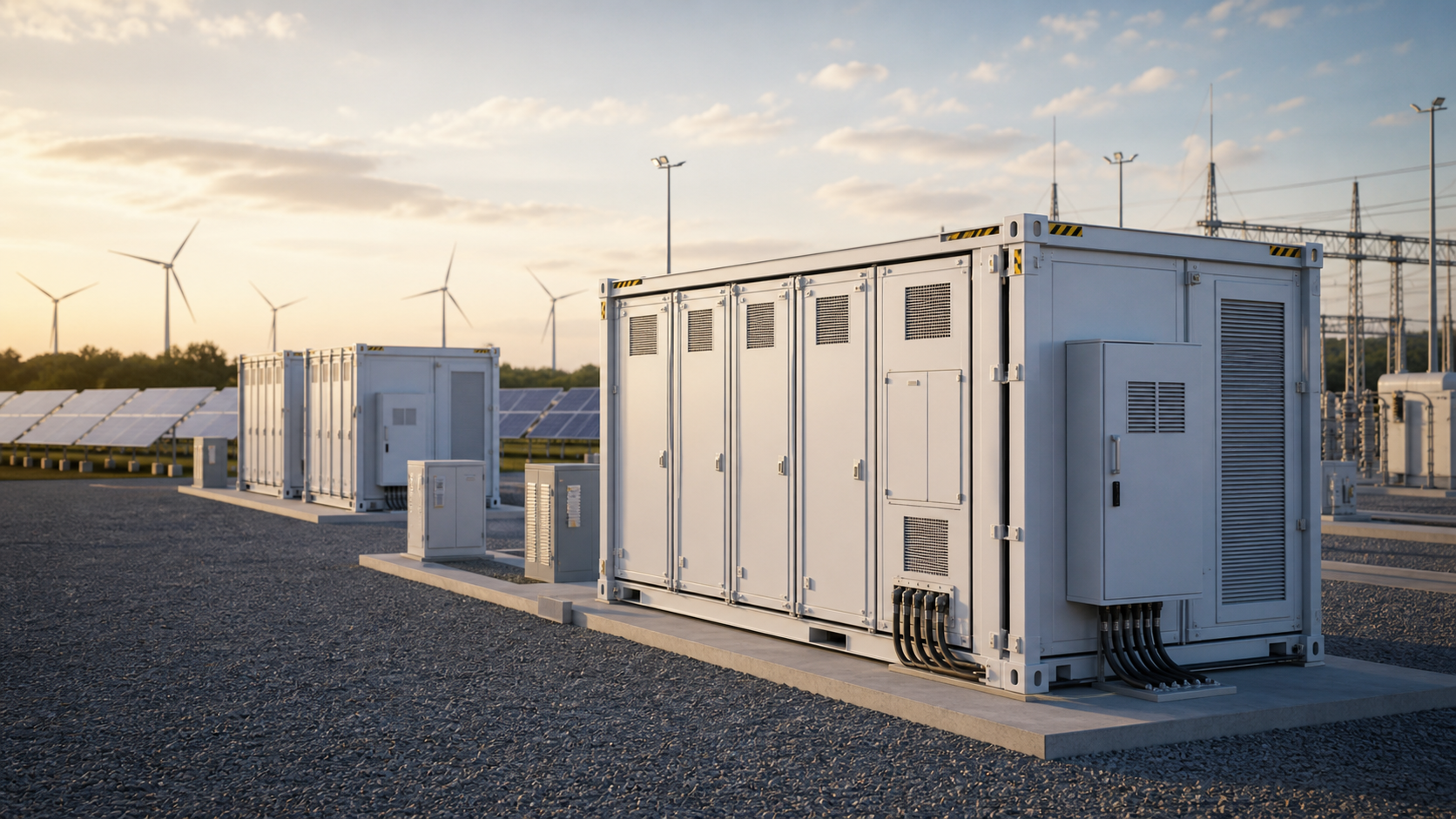
Ford is moving deeper into energy storage with a new product that has little to do with selling cars directly, but a lot to do with where the EV market is heading. Ford Energy, a wholly owned subsidiary of Ford Motor Company, is introducing a containerized battery energy storage system called the DC Block.
The system is aimed at utility-scale, industrial, and commercial customers that need large batteries for grid support, backup power, peak-load shifting, microgrids, and energy-price arbitrage. In plain terms, Ford wants to sell the kind of big battery container that can sit behind a factory, beside a solar project, or inside a utility storage site.
What Ford is building
The Ford Energy DC Block is a standardized 20-foot battery container built around 512-Ah lithium iron phosphate, or LFP, prismatic cells. Ford lists rated energy capacity at 5.45 MWh, with a DC voltage range of 1,040 to 1,500 volts.
Ford says the system will be available in 2-hour and 4-hour configurations. That matters because many grid-storage projects are designed around how long a battery can discharge at a useful power level, not just how much total energy it stores.
The container uses liquid-cooled thermal management, an IP55 ingress protection rating, C5 corrosion protection, and an operating-temperature range from -35°C to +55°C. Ford also lists noise below 75 dBA and a product weight of about 43.5 metric tons.
Why this is more than an EV side project
Grid storage is becoming one of the most important supporting industries for electrification. More renewable power, more data-center demand, more fast charging, and more weather-related reliability concerns all create demand for batteries that can absorb energy when it is available and discharge it when the grid needs support.
Ford is positioning the DC Block around practical buying concerns: domestic assembly, service support, regulatory readiness, and predictable lifetime performance. The company says it is developing energy-storage production in Kentucky and is targeting 20 GWh of annual manufacturing capacity.
That is smaller than Tesla’s Megapack ambitions, but it is still a serious number for a new entrant. Ford is also leaning on a familiar chemistry. LFP batteries are widely used in stationary storage because they offer strong thermal stability, long cycle life, and predictable operating economics.
How it compares with Tesla’s Megapack story
The obvious comparison is Tesla’s Megapack. Tesla has spent years building a lead in utility-scale storage, and its Megapack business has become a major part of Tesla Energy. Ford is not likely to erase that lead quickly.
But Ford does not need to beat Tesla overnight for this to matter. Utilities and commercial energy buyers often prefer multiple suppliers, especially when projects involve domestic-content rules, tax-credit planning, long service windows, and supply-chain risk. A Ford-backed storage product gives those customers another large U.S.-connected option to evaluate.
What happens next
Ford Energy says the DC Block will be available beginning in 2027. Until customer deployments begin, the product is still a planned storage system rather than a proven field asset.
Still, the move is significant. Ford is taking battery manufacturing knowledge, LFP technology, and its U.S. industrial footprint into a market that is growing beyond passenger EVs. For EV shoppers, the direct impact is limited today. For the broader charging and energy ecosystem, more grid-storage competition could help make large charging sites, commercial facilities, and renewable-heavy grids easier to support.