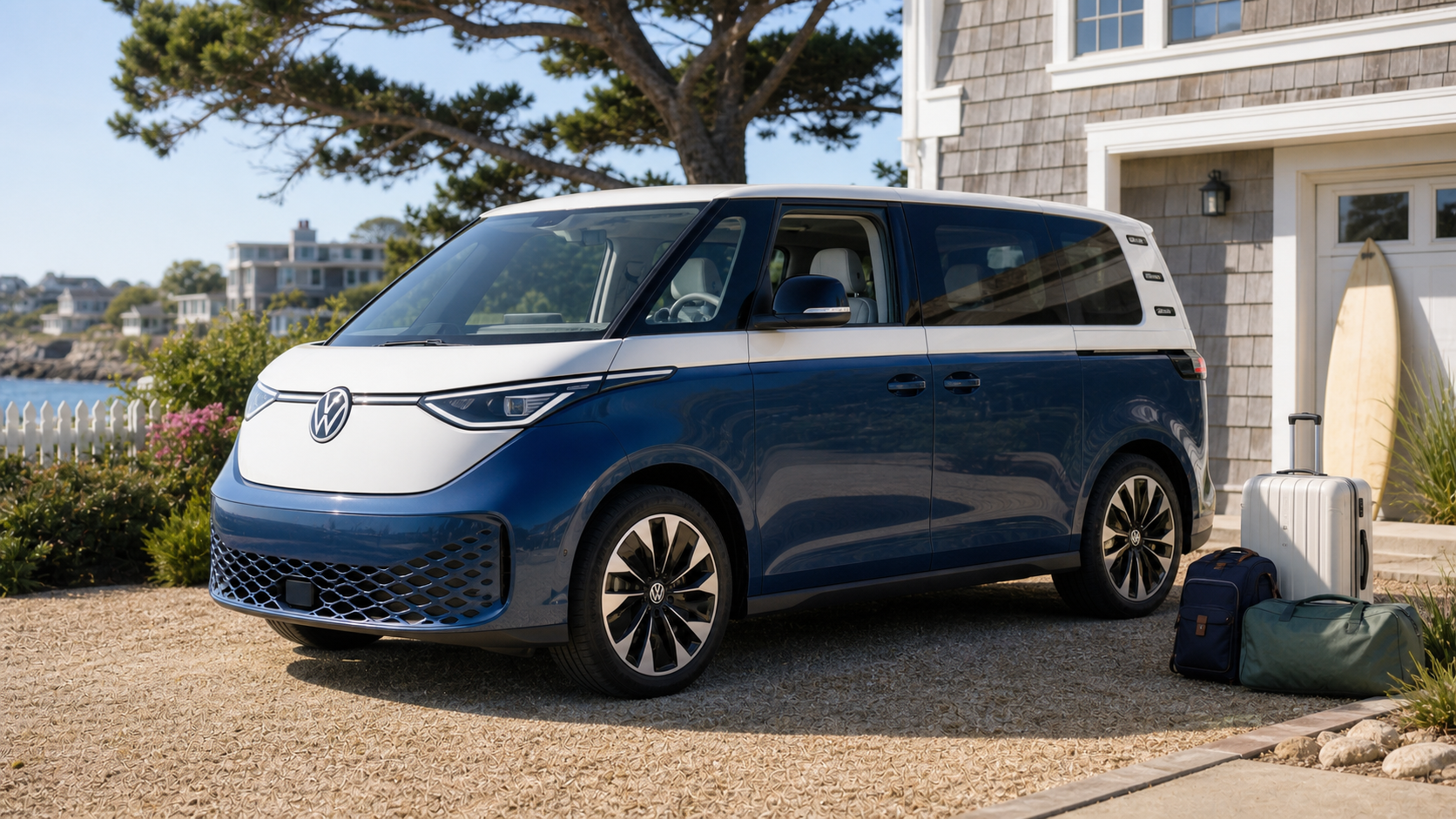
The 2025 Volkswagen ID. Buzz gives U.S. shoppers something rare: a three-row EV that feels more like a van than another crossover. Green Car Reports' review focuses on that unusual mix of space, nostalgia, range, and price.
For families, the ID. Buzz is appealing because its shape solves problems that many SUVs do not. The question is whether its range, charging, and price make sense against newer three-row electric SUVs.
What the U.S. version brings
Green Car Reports says the U.S.-spec ID. Buzz is longer than the European version, uses a larger 91-kWh battery pack, and carries an EPA range of up to 234 miles. Volkswagen technical data also supports the U.S. battery and range context.
Those details matter because the American version is not simply the short-wheelbase European van. It is built around three-row family use, with more space and battery capacity for U.S. expectations.
Why the shape matters
The ID. Buzz's biggest advantage is its body style. Sliding-door access, an upright cabin, and flexible passenger packaging can be more useful for some families than a sleeker SUV roofline.
That can matter for child seats, older passengers, pets, sports gear, and everyday cargo loading. For buyers who miss minivans but want an EV, the ID. Buzz belongs on the list because it offers a different answer than the typical crossover.
The value question
The challenge is price and range. Green Car Reports noted pricing that starts above $60,000 and rises for higher trims. At that level, shoppers will naturally compare the ID. Buzz with three-row EV SUVs that may offer different range, performance, or luxury features.
The EPA range of up to 234 miles may be enough for daily family use, especially with home charging. Road-trip families should look more carefully at charging speed, route coverage, cabin load, weather, and how often they travel long distances.
Who should consider it
Family shoppers should focus on fit, not nostalgia. If the cabin layout solves real passenger, cargo, child-seat, or accessibility problems, the ID. Buzz may justify compromises elsewhere.
If range, price, or highway charging flexibility is the priority, a three-row EV SUV may make more sense. The ID. Buzz is most compelling when its van-like usability is the reason to buy, not just its styling.